Top of Page
- Links to move inside this page.
- HOME
- Sustainability
- ESG
- Social
- IIJ Group Human Rights Policy
- Human Rights Due Diligence
Human Rights Due Diligence
Human rights due diligence is an ongoing process through which a company identifies, prevents, mitigates, and addresses adverse human rights impacts arising from its business activities, monitors the effectiveness of these measures, and communicates progress and outcomes to stakeholders.
In accordance with the IIJ Group Human Rights Policy , the IIJ Group has established and promotes a human rights due diligence framework to appropriately address human rights risks affecting its stakeholders.
Governance Structure and Framework
Governance Structure
Human rights due diligence initiatives are promoted by the Human Rights Working Group under the Sustainability Committee (Chair: Yasuhiko Taniwaki, President and Co-CEO & COO), in collaboration with relevant departments including Human Resources, Purchasing and Procurement, as well as business divisions across the Group. These activities are supervised by the Board of Directors.
Framework
In accordance with the IIJ Group Human Rights Policy, the IIJ Group continuously improves its initiatives through a cycle consisting of:
- Assessment and Identification of Human Rights Risks
- Development of Measures to Prevent and Mitigate Human Rights Risks
- Monitoring Effectiveness
- Information Disclosure and Accountability
Throughout this process, we engage in ongoing dialogue with stakeholders and strive for continuous improvement.
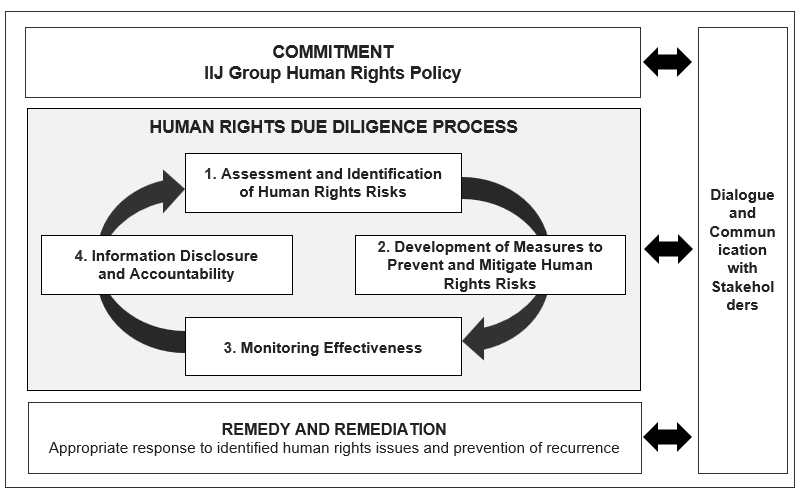
Human Rights Due Diligence Process
Assessment and Identification of Human Rights Risks
Approach
The IIJ Group evaluates human rights risk areas based on major international standards, assessing adverse human rights impacts associated with its business activities from the perspectives of severity and likelihood. In addition to desk-based assessments, our evaluation process incorporates employee interviews, dialogue with suppliers, and advice from external experts.
<Key Human Rights Risk Areas Assessed>
- Insufficient or Unpaid Wages and Living Wages
- Excessive and Unreasonable Working Hours
- Safe and Healthy Work Environment
- Right to Social Security
- Forced Labor
- Freedom of Movement
- Freedom of Association and the Right to Collective Bargaining
- Rights of Migrant Workers
- Child Labor and Children's Rights
- Discrimination and Harassment
- Human Rights Risks Associated with Technology and AI
- Right to Privacy
- Consumer Safety and the Right to Information
- Freedom of Expression
- Intellectual Property Rights
- Bribery and Corruption
- Rights of Indigenous Peoples and Local Communities
- Human Rights Risks Associated with Environmental and Climate Change Issues
- Human Rights Risks in Conflict-Affected Areas
- Right to Access Remedy
<Stakeholders>
- Employees and Workers (including employees of the IIJ Group and personnel engaged through outsourcing arrangements)
- Business Partners and Customers
- Local Communities and the General Public
<Assessment Criteria>
Severity
Assessed based on the scale, scope, and irremediability of adverse human rights impacts.
Likelihood
Assessed based on the probability of adverse human rights impacts occurring, taking into account past incidents, current management practices, and potential future risk factors.
Salient Human Rights Issues
Based on the assessment results, taking into account both the impacts on stakeholders and the relationship to our business activities, the IIJ Group identified the following six salient human rights issues as priority areas requiring focused action:
- Excessive and Unreasonable Working Hours
- Safe and Healthy Work Environment
- Discrimination and Harassment
- Human Rights Risks Associated with Technology and AI
- Right to Privacy
- Right to Access Remedy
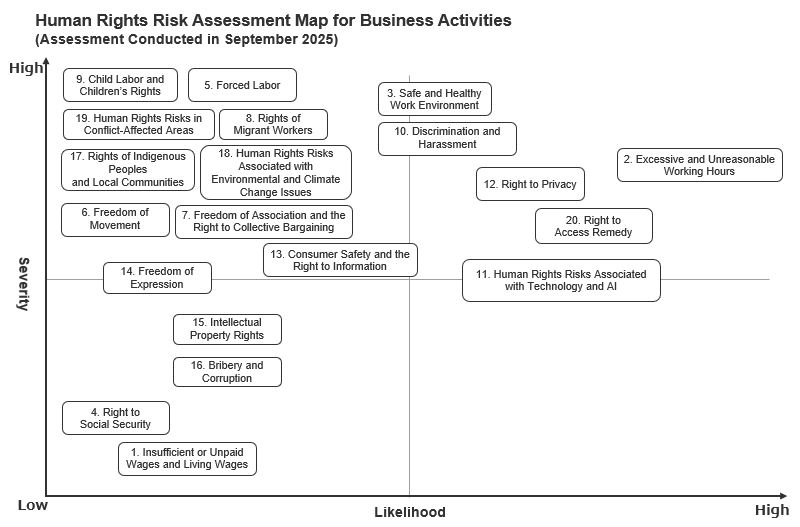
The assessment and identification of human rights risks are reviewed periodically through the human rights due diligence process and updated as appropriate in response to changes in business activities and the surrounding environment.
Response to Human Rights Risks and Monitoring
Focusing on the identified human rights risks, the IIJ Group promotes awareness and understanding of its Human Rights Policy and applicable laws and regulations through training programs and internal communications. At the same time, we seek to enhance visibility into human rights risks through assessments and interviews and implement appropriate measures to prevent and mitigate such risks. We are also developing mechanisms to monitor the effectiveness of these initiatives.
Key Initiatives
- Appropriate management of working hours and measures to prevent overwork
- Communication and awareness initiatives related to health maintenance and promotion
- Training programs for all managerial employees, including harassment prevention and information security
- Continuous improvement of employee consultation services
- Supplier assessments and interviews
Grievance and Remediation
Human Rights Consultation and Reporting Channels
For employees, the IIJ Group provides an Employee Consultation Desk, which accepts both named and anonymous consultations, as well as an Internal Whistleblowing System established under its internal control framework. These mechanisms enable the Group to appropriately address human rights-related concerns and grievances. The IIJ Group strictly prohibits retaliation or any disadvantageous treatment against individuals who raise concerns, make reports, or cooperate with investigations.
For suppliers, business partners, and customers throughout the value chain, the IIJ Group provides a dedicated Human Rights Consultation and Reporting Desk for Business Partners as a grievance mechanism.
Remedy and Remediation
Where adverse human rights impacts are identified through the human rights due diligence process or through consultations and complaints received via the grievance mechanisms, the IIJ Group will verify the facts, collaborate with relevant organizations and stakeholders as necessary, provide remedy to affected individuals, address adverse impacts, and implement measures to prevent recurrence.
- Related Contents
End of the page.