Top of Page
- Links to move inside this page.
- HOME
- About IIJ
- News / CSR
- Press Releases
- 2026
- Launch of a proof-of-concept experiment for a next-generation distributed AI processing infrastructure aiming to realize the Watt-Bit vision
Launch of a proof-of-concept experiment for a next-generation distributed AI processing infrastructure aiming to realize the Watt-Bit vision
Establishing an optical network infrastructure for the "KYOJO CUP" formula racing series
July 27, 2026
Nautilus Technologies, Inc.
Internet Initiative Japan Inc.
TEPCO Power Grid, Inc.
CHUBU Electric Power Grid
Fujitsu Limited
1FINITY Inc.

Tokyo, Aichi and Kawasaki, Japan, July 27, 2026 – Nautilus Technologies, Inc., Internet Initiative Japan Inc., TEPCO Power Grid, Inc., CHUBU Electric Power Grid, Fujitsu Limited, and 1Finity Inc., a Fujitsu company and leading provider of global network solutions, today announced the launch of a joint proof-of-concept experiment for a next-generation distributed AI processing infrastructure aimed at realizing the Watt-Bit Convergence Vision, under the New Energy and Industrial Technology Development Organization's (NEDO) "Study on the Validation of Low-Latency Distributed Processing Technologies for Next-Generation Infrastructure" (*1).
This proof-of-concept experiment aims to realize the distributed deployment of computing resources envisioned by the Watt-Bit Vision, a strategic framework that links electricity grids ("watts") and telecommunications ("bits") to optimize energy use and computing power. To this end, an All-Photonics Network (APN) (*2) will be constructed by combining optical fiber cables owned by TEPCO Power Grid and CHUBU Electric Power Grid with communications equipment provided by Fujitsu and 1Finity. By controlling the operating timing of GPU servers (*3) deployed at two geographically separated locations, the experiment will evaluate the feasibility of flexible adjustments in response to electricity demand conditions, while also validating the effectiveness of low-latency distributed processing technologies for operating these resources as a unified AI processing environment.
Specifically, this proof-of-concept experiment will use the final race of the "KYOJO CUP" formula racing series held at Fuji Speedway as its field environment. Real-time 4K video footage and telemetry data (*4) collected from onboard cameras and telemetry units (*5) installed in race cars will be gathered and transmitted via the APN through high-bandwidth, low-latency communications to GPU servers for AI-processing distributed across the TEPCO Power Grid and Chubu Electric Power Grid service areas. This enables the collected data to be processed by any of the GPU servers located across both service areas.
With demand for AI computing expected to continue growing, this proof-of-concept experiment will examine the feasibility of applying low-latency distributed processing technologies to utilize the power consumption of GPU servers as a resource for electricity supply-demand balancing. The demonstration will evaluate the practical applicability of these technologies toward achieving that objective.
This initiative represents Japan's first attempt (*6) to jointly operate geographically distributed GPU servers as a unified AI processing environment across areas with different utility frequencies (50 Hz and 60 Hz). Looking ahead, the project is expected to contribute to the realization of Watt-Bit Convergence by enabling AI workloads to be shifted to regions with surplus power capacity, thereby promoting more efficient utilization of electricity infrastructure.
The proof-of-concept period is scheduled to run from August 2026 to March 2027, with the proof-of-concept commencing from Round 3 of the KYOJO CUP series. Details of this proof-of-concept and its system verification results are expected to be presented at industry events, including Inter BEE (*7) , from autumn 2026 onward.
Reference 1: Roles of participating companies
The roles of each participating company in this proof-of-concept experiment are as follows.
| No. | Company | Role |
|---|---|---|
| 1 | Nautilus Technologies, Inc. | Provision of the database and technical support for the proof-of-concept environment |
| 2 | Internet Initiative Japan Inc. | Design of the network configuration within Fuji Speedway, hardware procurement, and integration of GPU services with the Fuji Speedway environment |
| 3 | TEPCO Power Grid, Inc. | Provision of optical fiber cables and hosting locations for GPU servers and telecommunications equipment |
| 4 | CHUBU Electric Power Grid | Provision of optical fiber cables and hosting locations for GPU servers and telecommunications equipment |
| 5 | Fujitsu Limited | Provision of optical NICs (*8) and technical support; construction of the optical network (including the provision of optical network systems) |
| 6 | 1Finity Inc. |
Reference 2: Infrastructure configuration of the proof-of-concept experiment
The GPU servers installed in the two locations are interconnected via optical fiber cables provided by TEPCO Power Grid and CHUBU Electric Power Grid, together with optical network systems provided by Fujitsu and 1Finity, enabling them to operate as a unified AI processing infrastructure.
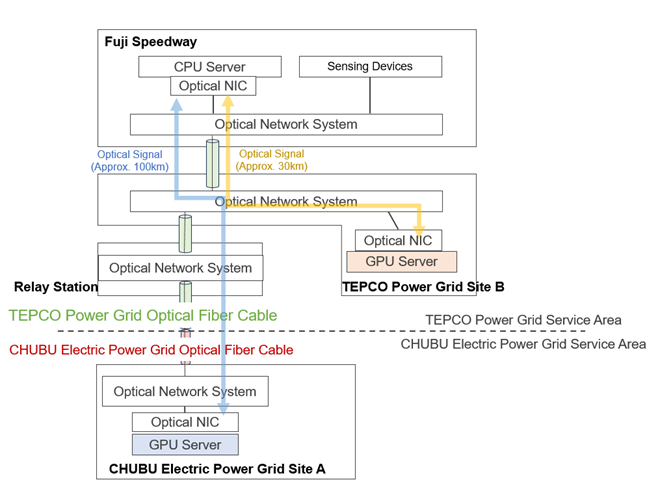
Figure: Infrastructure configuration of the proof-of-concept experiment
Reference 3: Key technologies utilized in the proof-of-concept experiment
All-Photonics Network (APN)
The All-Photonics Network (APN) is a next-generation communications infrastructure that processes information as optical signals wherever possible. In conventional communication networks, optical and electrical signals are repeatedly converted at each network device. APN minimizes these conversions, enabling low-latency, high-capacity, and energy-efficient communications.
For this proof-of-concept experiment, an optical Network Interface Card (optical NIC) currently under development by 1Finity and scheduled for commercial release in October 2026 will be deployed. By utilizing the optical NIC, servers located more than 100 kilometers apart can be directly interconnected using optical signals without relying on conventional Layer 2 and Layer 3 switches or routers.
This approach further reduces communication latency while leveraging proprietary technologies to minimize performance degradation over long-distance connections.
Next-Generation High-Performance Relational Database "Tsurugi"
This proof-of-concept experiment employs Tsurugi, a next-generation high-performance relational database (RDB) developed in Japan, as the core database of the system. Support and architecture design for the system are provided by Nautilus Technologies, Inc.
Tsurugi is an open-source next-generation relational database developed in Japan with support from the New Energy and Industrial Technology Development Organization (NEDO). It is designed to deliver high transaction processing performance and scalability while providing an end-to-end domestic support and manufacturing framework.
Tsurugi is also being enhanced to support future AI-driven applications. In addition to supporting AI integration technologies such as the Model Context Protocol (MCP) (*9), it provides a mechanism for seamlessly utilizing remote GPUs directly from the database through user-defined functions (UDFs) (*10) .
These capabilities enable efficient integration between the data management platform and the AI processing infrastructure, contributing to the realization of low-latency AI processing in this proof-of-concept experiment.
Notes
- (*1)Survey on the effectiveness of low-latency distributed processing technologies for next-generation infrastructure
This survey is being conducted as part of efforts to maximize the outcomes of NEDO's Technology Development Project for AI Chips and Next-Generation Computing for High-Efficiency and High-Speed Processing.
The survey aims to collect information on the latest developments in low-latency distributed processing technologies, which are increasingly recognized as a key technology for next-generation information infrastructure. It also seeks to identify use cases in which such technologies are expected to be more effective than conventional communications technologies and to evaluate their effectiveness through field verification. This proof-of-concept experiment is being conducted as part of those field verification activities. - (*2)A next-generation communications infrastructure that processes information using optical signals to the greatest extent possible during data transmission.
- (*3)A high-performance server equipped with Graphics Processing Units (GPUs) for large-scale computational workloads such as AI and machine learning.
- (*4)Driving data such as vehicle speed, engine ,speed accelerator position, brake operation, and gear position.
- (*5)An onboard measurement device that collects and transmits data related to vehicle operation and behavior.
- (*6)Based on research conducted by the participating companies as of July 2026.
- (*7)Inter BEE: One of Japan's largest exhibitions for broadcasting equipment, video and audio technologies, and content distribution solutions.
- (*8)Optical Network Interface Card (Optical NIC):A hardware component that enables network connectivity and data transmission/reception. By directly processing optical signals, it facilitates long-distance, ultra-high-speed communication while improving network performance and efficiency.
- (*9)A standard protocol that enables AI systems to securely and efficiently access and utilize information by connecting AI with databases, business systems, and other data sources.
- (*10)User-Defined Functions (UDFs) are functions that users can independently define and add to extend database capabilities, enabling databases to invoke and utilize external systems and computational resources such as GPUs.
About IIJ
Founded in 1992, IIJ is one of Japan's leading Internet-access and comprehensive network solutions providers. IIJ and its group companies provide total network solutions that mainly cater to high-end corporate customers. IIJ's services include high-quality Internet connectivity services, systems integration, cloud computing services, security services and mobile services. Moreover, IIJ has built one of the largest Internet backbone networks in Japan that is connected to the United States, the United Kingdom and Asia. IIJ was listed on the Prime Market of the Tokyo Stock Exchange in 2022. For more information about IIJ, visit the IIJ Web site at https://www.iij.ad.jp/en/.
About Fujitsu
Fujitsu's purpose is to make the world more sustainable by building trust in society through innovation. As the digital transformation partner of choice for customers around the globe, our 100,000 employees work to resolve some of the greatest challenges facing humanity. Our range of services and solutions draw on five key technologies: AI, Computing, Networks, Data & Security, and Converging Technologies, which we bring together to deliver sustainability transformation. Fujitsu Limited (TSE:6702) reported consolidated revenues of 3.5 trillion yen (US$23 billion) for the fiscal year ended March 31, 2026 and remains the top digital services company in Japan by market share. Find out more: https://global.fujitsu/en-global
About 1Finity
1Finity, a Fujitsu company, is a global provider of communications networks for our connected world. We uniquely combine technological leadership and expertise in open optical and wireless networking, network automation, and applied AI/ML to design, build, operate, and maintain critical digital communications network infrastructure. Collaborating closely with ecosystem partners, we deliver transformative outcomes for service providers and network operators, and enable them to lower TCO, improve network performance, and increase energy efficiency. For more information, visit www.1Finity.com
- Press Contacts
-
IIJ Corporate Communications
 +81-3-5205-6310
  press@iij.ad.jp
-
Fujitsu Limited
-
1Finity Inc.

All company or product names mentioned herein are trademarks or registered trademarks of their respective owners. Information provided in this press release is accurate at time of publication and is subject to change without advance notice.
Date: 27 July, 2026
City: Tokyo, Aichi and Kawasaki, Japan
Company: Nautilus Technologies, Inc. , Internet Initiative Japan Inc. , CHUBU Electric Power Grid, TEPCO Power Grid, Inc. , Fujitsu Limited, 1FINITY Inc.

- Related Contents
End of the page.